Visar inlägg med etikett dick pound. Visa alla inlägg

2008-03-21

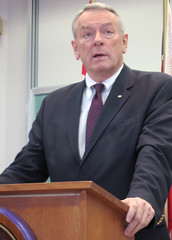
Dick Pound's Righteous Fury Causes Lawsuit

Story written by Eric.

You either appreciate his hard stance or you don't.

Richard "Dick" Pound's subtlety has on more occasion than not been in serious deficiency, and he's been warned by athletes and their attorneys as well as entire sporting entities alike to pipe down on his negativity toward them without having proof to substantiate claims they had either complicitly participated in on-going doping or were covering it up.

Pound had even backed himself and WADA into corners at times due to his brazen style and in-your-face manner of speaking.

Pound has been a one-man marching band who's played a tune which strikes out hardly and loudly out at suspected drug-takers, and he has not been shy at defending a set of values to which he upholds the insitution of sport.

He has bumped heads with Marion Jones, and he's clawed and boxed against the entire sport of cycling, stating on occasion that they - like USATF (the American track and field governing body) - had been slow in dealing with apparently open problems within their sport and had not acted in good time to prevent further scandal from breaking out.

Pound's unrelenting nature has gotten him into an issue with UCI, who, on Thursday, released a statement that it was suing Pound before Swiss courts for "continual injurious and biased comments" against world cycling's ruling body and its president Hein Verbruggen.

"On many occasions Mr Pound has publicly questioned the extent of the UCI's efforts in the fight against doping," the short statement concluded.

"He shoots any target he can, left and right. I'm fed up of him discrediting my athletes," Verbruggen once stated of Pound following the 2003 L'Equipe leak which stated the way riders were notified about being tested allowed room for cheating.

Pound appears to be facing issues stemming from his having questioned the UCI's willingness to fully investigate a 2005 L'Equipe's accusation that Lance Armstrong doped and wondering whether UCI was merely looking to accuse UCI and use it as a "scapegoat."

Pound may (not) deserve the lawsuit he’s believed to have brought upon himself, this despite having been construed as being a brash, take-no-prisoners dictator. His goal is now - and has always been - to keep sport clean, even as he attempts to head to the vacant Court of Arbitration for Sport position open.

Pound believes in clean sport, but has less belief in athletes' ability to play within the rules - and between the lines.

"Here’s the deal," he says.

"The shot-put weighs this much. The race is so many laps long. You can’t hollow out your shot-put and make it 12 pounds instead of 16. You don’t start before the gun. Run 11 laps instead of 12.

"And part of the deal is don’t use these drugs. It’s kind of an affirmation when you show up at the starting line. You are making an affirmation that you are playing the game the way it is supposed to be played.”


Pound may have had justice on his side through WADA as far as world-wide disciplining is concerned, but the UCI is taking Pound to a justice department in Switzerland for disciplinary procedures for flapping off at the mouth - a tool which he has used to state in no uncertain terms that he has believed the USA had drug issues it had swept under the rug.

Pound has made no secret that he believes the USA is involved in cover-ups, especially when it comes to Carl Lewis having tested positive for low levels of drugs found in Sudafed, and being permitted to participate in the 1988 Olympics, nonethless.

Pound considers the Lewis affair one of an anti-doping violation, and Lewis' participation in Seoul illegal.

Pound, engaging the United States directly – one of his biggest targets in the fight against doping due to what can be perceived as cover-ups, sounded off in a New York Times piece dated 2007-January-7, stating:

“There aren’t too many people who are prepared to point the finger at America and say: ‘Hey, take off the [expletive] halo. You’re just like everybody else.’ That’s a problem in America. America has a singular ability to delude itself.”

On another occasion last year, Pound told the UK Telegraph:

"It's a matter of confronting cheating when you see it," he says.

"There is organised cheating going on and it's not going to go away if we all hold hands and say 'ummmm'. These are people who know the rules and in 99.9 per cent of cases they don't give a shit about them. They're destroying sport and taking rewards away from fellow athletes.

"If you're not being confrontational, you're not doing your job. Being confrontational, you're going to attract some static. It's like when you're fighting. The most dangerous time for any boxer is when he's just scored a very good punch. It's the retaliation you've got to look out for. I'm happy to be known by my enemies. Nobody who is playing fair is mad at me."

One question which arises, however, is what kind of fingerprint he wants to leave on the sport of athletics, and what kind of legacy he will have left imprinted on sport in general if UCI has their way and has a muzzle put on Pound.


Pound has an opportunity to help rid the sport of cheats and uncover the other BALCO types out there, namely other lines of chemists, coaches, athletes and trainers who are involved in doping schemes hidden to the outer circle looking in.

He has changed a bit over the past year, meeting Victor Conte in January and going over war stories and strategies to build a better, more viable drug-testing method to test the crooks.

However, if he continues pressing on at all costs in a solo fashion - destroying chains of command in the process - folks will be less than willing to point him in the right direction, and he may be taken to town again by less enthusiastic folks than UCI.


Sport, according to the ancient Greek tradition, was broken down into two elements within the participants: the harmonious development of mind of body - agon, if you will, and arête - the conscious ideal of perfection.


Athletics - along with other sports within the Olympic movement - can be restored to a more even playing ground where athletes are competing clean over time, and the harmony between the pursuers and those pushing the envelop to cheat is smoothed out.

As more wisdom is applied to the fight against doping, and athletes are held even more accountable for their crimes against the sport, fans can appreciate sport for what it is: entertainment and excellence.


In order to effect this change - where mind and body develops naturally in the absence of drugs, Dick Pound would be of better service if he continues his fight quietly - away from the headlines - and not create a perception of being a one-man show.

If he is unsuccessful, and his desire to stand at the centre can not be quashed, folks will lose faith in the organisation as a whole - when it is Pound with whom they have their disagreement.

One thing is for certain, however, Pound, a tax attorney, won't be afraid to stand before a court full of his peers.

Pound photo #2 courtesy of Wired Magazine

2008-02-15

Can Conte Clean Up Athletics?

Story written by Eric


Victor Conte has worn a lot of hats in his professional life, but nothing like the larger than life one he's trying on at newspaper outlets near you.

Conte has also worn several labels across his chest of late, with the latest outing another peculiar one in which the former bass guitarist was seen bearing the letter "S" whilst seated with long-time adversary Dick Pound, the former head of WADA.

Conte, a former musician who turned into an overnight nutritionist, has been periodically called a liar, a cheat, a serpent and a thief by some very grown-up men within the United States government who wield powerful job titles and appear fuelled by a supply of natural, non-synthetic testosterone.

That's the mild version for the PG-13 readers.

I doubt Conte's life ambitions are to demonstrate how well he can squirm on his belly -- especially with his company, SNAC, raking in considerable amounts of cash and Conte reaping the benefits. So there must be another explanation for the label and hat Conte has been seen wearing with greater frequency over the past six weeks.

Consider that he's also been called a very bad man for luring unsuspecting athletes away from natural hard work and sweat into a life of lies, lies and more lies mixed together with a cover-up or two in an effort to level out a playing field in athletics he believes is littered with illegal drugs.

He's also been labeled self-serving and unappreciative of the spirit of true competition, and has been cast off as a bitter man whose true interests in sport are in plaguing the purity of the Olympic games.

So what does that solid-colored "S" planted above Conte's chest represent?

That "S" jumps out at a person very suddenly and without fail each and every time drugs controversy within athletics sprouts up and every conceivable tie between performance-enhancing drugs is made between an athlete caught for doping and Conte, the brain-child behind one of the most prolific and previously well-kept doping secrets in all of professional sport.

The phenominem occurs as though Conte, 58, has somehow mysteriously become omniscient, and he has been given an elevated, god-like status as a result of it.

Conte gets the call when a Dwain Chambers-type returns from a drug ban -- from using Conte's products, nonetheless, and gets on a black list rather than an "A" list within European meet organizers' athletics events.

He chimes in when a Marion Jones quacks for mercy in a courtroom only to be ushered off to six months of day-care 100 miles from her home instead of a slap on the wrists and probation.

It seems every time a track athlete is caught up in a moment of controversy and drugs are involved, Conte has his nose in everyone else's business but his own -- unless shedding light on the drug problem has become his business.

Conte was jailed in 2003 for improprieties relating from his illegal and immensely popular BALCO dealings with sports stars ranging from major league baseball players to track and field athletes, and professional cyclists to NFL stars.

He spent a total of eight months under lock and key -- four at a minimum-security prison camp, and four home-confined.

He stated to journalists after Judge Susan Illston sentenced him that he had hoped he could turn around the incredible amount of wrongdoing into positives for athletes and the fans who watch them compete, and even asked the current sitting President of the United States of America, George W. Bush, to intervene on his behalf so that Conte could make a concerted effort to help America send a "clean" team to Athens to compete in the Olympic Games.

"It is said that I have become the poster child for the wrongdoing in Olympic as well as professional sports," he said outside the court. "Ironically, I find myself as someone qualified to help solve this problem plaguing sports, precisely because I've been a major contributor to the controversy."

So does that make Conte, who has since moved on from BALCO and become a fixture within the sport, a savior, a sinner or a saint?

Try Superman.

Among the many labels Conte has had pegged on to his character, he has also been labeled an opportunist -- a man who rarely misses a step or a beat when occasion lends itself for him to capitalize and make good on his talent to sell.

Perhaps that is what Conte is now doing to whoever will sit and listen, namely selling them on a similar notion he asked former athletes to purchase for a price -- one which saw many of them lose honors, prizes and esteem once they were discovered to have cheated.

Conte's pitch today, however, isn't that one must cheat to win, rather that the current state of testing for performance-enhancing drugs is unacceptable, because the testers are completely off key in their pursuit of the cheaters.

Track and field is suffering a critical blow with a public which believes just what people like Conte are stating, and what scribes are printing, namely that superstar athletes compete dirty and will continue to do so until someone steps up to their calling and helps turn over all the stones where the athletes, their coaches and their distributors are hiding their stashes.

Conte believes he is just the one for the job, supported by the following story.

Conte has been an eyewitness not only to the effect drugs can have on athletes, but has keen experience hiding out and waiting for time to pass on, for drugs to pass through, and for athletes to pass tests over and over and over again to their heart's content and to his own personal satisfaction with helping enable the deception to have remained covered.

Conte made the following remark recently when Chambers recently made news for an over-blown story, which has embarrassed UK Athletics and the British Olympic Association.

"I still think there is rampant use of drugs out there. It can be cleaned up but they have to use people from the other side, like Dwain and myself, and use the knowledge we've gained. Then, when athletes truly believe it is much more difficult to circumvent the testing, you'll see far more performances by athletes who are doing it with hard work as opposed to chemical substances."

Indeed, athletes and coaches, trainers and even agents do know where the minefields are, and they know which steps must be taken in order to successfully navigate through them. Is it possible that such persons, working on their own initiative following drug bans, could be of use to anti-doping organizations in their fight to stamp out drugs in sport?

Perhaps they can, but in Chambers' case, his federation believes it can be done outside of the track and away from the field.

Is it likely that Conte, on the other hand, who doesn't lace up spikes to sprint down a track at breath-taking speeds, can be Superman in this story and help the World Anti-Doping Agency and the United States Anti-Doping Agency run faster than a speeding cheat and leap tall buildings to catch up to them?

Pound, who had ridiculed Conte in the past for littering the sport with druggies and copping out by not testifying in his trial about his affairs, met with Conte on 2007-December-7 to shed light on such matters.

According to both parties involved, the meeting they had was productive, and both men looked forward to sharing more as time elapsed and cards began to fall into place.

Conte has helped athletes cheat, and he has helped those athletes cover up their sins against the sport. He is a convicted criminal with a felony record, and has had his life temporarily interrupted by the Department of Justice Federal Bureau of Prisons and the California Corrections, Probation Department.

He is also a man who says he is sitting on a wealth of important information, and he seems willing and ready to spread his sermon to whoever has the time, patience and willingness to listen.

Will track and field, which is scratching for respect, find ties with Victor Conte which positively bind and won't snap?

Stay tuned to find out.

2007-01-16

WADA Under International Fire

Story written by EPelle

WADA, suffering an apparent international rebellion by international sports officials over the current anti-drug enforcement system - one which is regarded by critics as harsh and inflexible, has been called upon to havemajor rules revisions, according to documents released Monday.

The Los Angeles Times reported today that among the international sports officials' main concerns is WADA's stance on trace amounts of banned substances which provide the same consequence as intentional drug use - cases which, the LA Times states, often impose identical penalties in either case (source).

The current system, the LA Times quotes, is "far too oversimplified" and can lead to "absurd" results according to the Association of Summer Olympic International Federations. WADA is being pressed to give anti-doping enforcement authorities around the world more flexibility and autonomy to reduce sanctions — or impose none at all — as they see fit on specific athlete cases where drug violations are found to be accidental or trivial.

The comments from agencies ranging from the International Olympic Committee and other agencies - including world-wide athletics national governing bodies - were solicited by WADA and collected over a six-month period as part of a checks-and-balances review process for the World Anti-doping Code, which was first implemented four years ago.

WADA officials have portrayed a united front in both its goals for drug-free competition and its enforcement methods, and it is not known how much influence the criticisms and proposed changes made by the officials would have on revised Anti-doping Code language when it is submitted for approval by the 36-member WADA board at WADA's annual meeting, World Conference on Doping in Sport, 15-17 November in Madrid.

Among the most harsher points brought up in the documents, sports officials have criticized WADA for two main issues: punishing athletes on the basis of unreliable lab tests and WADA's principle of "strict liability," whereby athletes are sanctioned for drugs violations when banned substances in an athlete's blood or urine sample are found at trace-amount levels.

"It does not seem fair that athletes who 'innocently' transgress the rules, strict liability notwithstanding, receive the same penalty as those who have purposely set out to cheat," stated David Gerrard, New Zealand's anti-doping agency chairman.

One area which has been of great concern to athletics is the three Carl Lewis "positive" tests from the USA Olympic Trials in 1988.

Pound, though not having been mentioned by name, was understood as having been criticized in the international documents for appearing prejudgiced of accused athletes who were awaiting pending appeals processes for their cases.

American Marion Jones was not mentioned, however, nor was her EPO test which Pound stated he would have re-analysed to the extent that he nearly crossed a line in calling the UCLA laboratory negligent for not calling the "B"-sample reading positive. Pound has been critical of Jones since her alleged involvement with BALCO - making it a mission to bring her to some sort of justice in the fight against dopers.

The LA Times wrote today that the WADA code has set strict-liability relief standards which are virtually impossible to meet according to sports officials.

One problematic area which is certain to come under fire is the degree which countries should be allowed to call a trace-amount positive and malfeasance, and when one has inadvertantly tested positive.

Pound considers the 1988 Carl Lewis three positive tests anti-doping violations, and has stated that Lewis' participation in Seoul was illegal.

United States officials took action into its own hands in 1988 when Lewis stated to them he had taken cold medication which later was found to contain a banned substance, causing him to test positive on three separate occasions before he competed in the Summer Olympics.

Lewis, who did not inform anti-doping officers of the substances found in his medication - violating a rule already set in place, was found to have born little or no fault/no negligence when trace amounts of banned substances where found in his system on three separate occasions - substances, he claimed, were from taking cold medications.

Pound has made no secret that he believes the USA is involved in cover-ups, especially when it comes to Lewis having tested positive for low levels of drugs found in the Sudafed he stated he had taken, and subsequently being permitted to participate in the 1988 Olympics, nonethless.

Pound, engaging the United States directly – one of his biggest targets in the fight against doping due to what can be perceived as cover-ups, sounded off in a New York Times article, stating:

“There aren’t too many people who are prepared to point the finger at America and say: ‘Hey, take off the [expletive] halo. You’re just like everybody else.’ That’s a problem in America. America has a singular ability to delude itself.” (blog link).

WADA has a load of issues to consider as it attempts to shore up its anti-doping efforts around the globe in an attempt to unify organisations' strategies and stances to combat doping - inadvertant or not.

Should they be oberseved as seriously taking into consideration measures and efforts to unify the world agencies' request without diluting the purpose for which WADA has been created, sports officials and atheltes may put more faith into the processes and procedures WADA has on the table, and will perhaps buy into a system which may seem fairer and more just than the current model.