Visar inlägg med etikett kenenisa bekele. Visa alla inlägg

2008-03-29

Tadese Feels Good, Ready to Tackle Bekele Again

Story written by Eric.

Don't blame Zersenay Tadese if he prefers the taste of gold over silver or bronze. He's risen up in the athletics world and can afford to be picky over which one he appreciates over another.

Tadese, the returning IAAF World Cross Country gold medalist from Eritrea, earned his stripes under oppressive and life-threatening conditions in Mombassa, Kenya last March.

Tadese, now 26, took the Kenyan heat and humidity by the neck and fired up his own storm on the course, breaking Kenenisa Bekele's stride and spirit along the way to win his first world championship and ending Bekele's stronghold at the top at five-consecutive wins.

The two powerful men who both possess an amazing supply of strength, will-power and determination, will be back at it again on Sunday, facing off together over the long course race in Edinburgh's Holyrood Park in the 36th edition of this early-season fitness test during the Olympic year.

Bekele, who is attempting to win a sixth title and break a tie he holds with two legends - John Ngugi and Paul Tergat, both of Kenya, is focussing on a one-off race this time around after winning 10 gold medals in the past 12 men's events contested over both the long- and short-course events.

Bekele was on target last season to make a serious late-race bid to break away from the field - which was collectively suffering from exhaustion and severe heat loss, but was unable to shake off Tadese, who crept up to Bekele and would not be intimidated by the 24-year-old Ethiopian multiple world record-holder.

Bekele made a hard move to shake his rival, who had never before defeated him on the fields, but paid a heavy price in the race and was forced to abandon his plans to repeat as champion and to continue on with regular training for two months following that endeavour.

Tadese, on the other hand, had an opportunity to shake off the field at his calling and dictate a race pace from up front which punished any pursuers not already within an armshot of him.

The reward? A golden opportunity he would never forget.

Tadese was no slouch on the cross country course prior to winning last year's world championships, nor was he a lightweight on the track.

Having won the 2006 World 20km championships, Tadese also brought 12.59,27 and 26.37,25 personal bests also set in 2006 to keep his focus up with Bekele and to block out the heat - something he had been working on at his training base in Spain.

Both men are looking forward to tomorrow for different reasons.

Bekele, who has raced sparingly this season - recording a world-record in the 2-mile indoors in Birmingham (8.04,35) and a 12km cross country victory on this very Edinburgh course in January, is attempting to regain the crown which eluded him last year and set himself as the overwhelming favourite to win the Olympic 10.000m crown in August in Beijing.

A victory over his rivals would mean that Bekele's forced withdrawal last year was due solely to the elements, and not to being outdone by his rivals.

A loss, on the other hand, would keep Bekele on his competitors' radars and make him even more vulnerable to defeat than he was when he had to dig down deep in Osaka's 10.000m final at last summer's IAAF World Track & Field Championships.

Tadese, whose season has been derailed by two losses in three cross country competitions - including a tick in the ledger against Bekele in Edinburgh, is out to run his own race and compete his best against the entire field, not just Bekele.

"It’s not a matter of fearing anyone," he told the IAAF on Saturday. "I just run my own race."

A race is what the fans lining up the course in rainy conditions will get from two fresh athletes who both know the feeling of victory and the pursuit of near perfection as they tread over water holes, through the mud and push their bodies to their limits for about 34 minutes of time.

Tadese lost a close one to Bekele on 12-January, with the steely Ethiopian stating afterward that it was a very important victory for him. The race was contested over a 9,3km layout on this very site.

Bekele, the world record-holder at 5.000m and 10.000m, looks to be a favourite in a race up to 12km, or the distance contested at the World Championships.

Tadese, on the other hand, has virtually snuck up on the world, having run 58.59 over the half-marathon distance to win last year's IAAF Half Marathon World Championships in October and set a national record in the process. His 10.000m ability may now be faster than the listed 26.37,25 he was able to set in finishing second to Kenyan Micah Kogo in Bruxelles.

The combination of improved track times and excellent road times may hold a slight advantage for Tadese over a longer distance, but Bekele, who has continually demonstrated excellent sprint speed at the end of long track races, may yet pull one out against anyone in the field who is near with only a surge and a kick the only thing separating the victor from the finish line.

At any rate, the vibes are hot, the athletes are cool, and the fans hope the weather warms as the senior men and women as well as the junior division athletes embark on a mission which should last each participant a lifetime.

This is a first-of-a-kind for many of the junior athletes, who are 19-years-old and younger, and is meant as a stepping stone for them to make their way to the senior ranks.

Bekele was 9th in the 1999 junior division in Belfast, and came back to win the 2001 junior title in Ooestende.

The Kenyan men's senior team will have five athletes who are making their senior debut.


IAAF World Cross Country Championships
Holyrood Park, Edinburgh, Scotland
Race Times:

13.00: Women's Junior Race. Start List.
13.30: Men's Junior Race. Start List.
14.05: Women's Senior Race. Start List.
14.45: Men's Senior Race. Start List.

Zersenay Tadese's Cross Country and Road Racing Merits:

20 Kilometres
  • 1st IAAF World Road Running Championships 1 f 56:01 Debrecen 08/10/2006
Half Marathon
  • 2nd IAAF World Road Running Championships 1 f 58:59 Udine 14/10/2007
  • 12th IAAF World Half Marathon Championships 7 f 1:01:26 Vilamoura 04/10/2003
  • 11th IAAF World Half Marathon Championships 21 f 1:03:05 Bruxelles 05/05/2002
Senior Race
  • 35th IAAF World Cross Country Championships 1 f 35:50 Mombasa 24/03/2007
Long Race
  • 34th IAAF World Cross Country Championships 4 f 35:47 Fukuoka 02/04/2006
  • 33rd IAAF World Cross Country Championships 2 f 35:20 St Etienne - St Galmier 20/03/2005
  • 32nd IAAF World Cross Country Championships 6 f 36:37 Bruxelles 21/03/2004
  • 31st IAAF World Cross Country Championships 9 f 37:10 Lausanne 30/03/2003
  • 30th IAAF/Sport Ireland World Cross Country Championships 30 f 36:37 Dublin 24/03/2002
Kenenisa Bekele's Cross Country Merits:

Junior Race
  • IAAF World Cross Country Championships 1 f 25:04 Oostende 25/03/2001
  • 27th IAAF World Cross Country Championships 9 f 26:27 Belfast 28/03/1999
Short Race
  • 34th IAAF World Cross Country Championships 1 f 10:54 Fukuoka 01/04/2006
  • 33rd IAAF World Cross Country Championships 1 f 11:33 St Etienne - St Galmier 19/03/2005
  • 32nd IAAF World Cross Country Championships 1 f 11:31 Bruxelles 20/03/2004
  • 31st IAAF World Cross Country Championships 1 f 11:01 Lausanne 29/03/2003
  • 30th IAAF/Sport Ireland World Cross Country Championships 1 f 12:11 Dublin 23/03/2002
  • IAAF World Cross Country Championships 2 f 12:42 Oostende 24/03/2001
Long Race
  • 34th IAAF World Cross Country Championships 1 f 35:40 Fukuoka 02/04/2006
  • 33rd IAAF World Cross Country Championships 1 f 35:06 St Etienne - St Galmier 20/03/2005
  • 32nd IAAF World Cross Country Championships 1 f 35:52 Bruxelles 21/03/2004
  • 31st IAAF World Cross Country Championships 1 f 35:56 Lausanne 30/03/2003
  • 30th IAAF/Sport Ireland World Cross Country Championships 1 f 34:52 Dublin 24/03/2002

Stats courtesy of IAAF

2008-03-13

2008 World Indoor Champs: Inside the Men's 3K

Story by Eric

The 2008 IAAF World Indoor Championships were exciting on several fronts, with athletes mentioned in previous stories on this site gaining more than their fair share of headlines both here and in other international press.

Today's meet reflection looks at the men's 3.000m, and one particular athlete's struggle to gain solid footing on his own. He's chased titles, shadows and respect for far too long. His victory in Valencia may have pushed him over the top, and provided him his own stature and name in a sport littered with stars, and in a family where one man has won world cross country titles, junior cross country titles, world championships, an Olympic gold medal, and has set world records indoors and outdoors.

That man, though only 19, is known as Tariku Bekele, and he may become the first one thinks of when the surname Bekele is said if he can carry his momentum forward and challenge the rest of the world outdoors like he did indoors this season, when, at the week-end, he knocked off the 2007 World Champion at the steeplechase (Paul Koech), and a 3.48 miler in Australian Craig Mottram among others in Spain.

Sit back, take down some notes, and learn as much as you can from this rich information digested from the men's 3.000m race.

Men's 3.000M

Tariku Bekele had long been in his brother's shadows since the start of his career on the youth and junior levels, and had also been overshadowed this season when Kenenisa broke countryman and mentor Haile Gebrselassie's world indoor record in the 2-mile, running 8.04,35 in Birmingham.

It didn't matter that the younger sibling had chased his elder brother out of the national junior ranks at the 3.000m outdoors, his brother's mark was one which set a world standard, whilst Tariku Bekele's was a national one.

Nor did it matter that he had played pace-maker to several world record attempts Kenenisa Bekele made at 5.000m, Tariku Bekele's name did not stand next to any world records as did his brother's.

Finally, as 3.000m races go, the best Kenenisa Bekele had accomplished at a major championship as a junior was winning the 1999 World Youth Games silver medallist. Tariku Bekele, running in his brother's long, extended shadow, also captured a silver medal, collecting his hardware four years later in Sherbrooke.

Tariku Bekele's victory in Valencia changed a bit of luck for the young star, however, and provided him with several distinctions to go along with the $40.000 he pocketed for his victory.

Key observations from the race:

  • Though Tariku Bekele was unable to claim the fastest mark in the family indoors at 3.000m - he trails his brother by 0,58 seconds, he was able to step into new territory this winter by running the fastest time in the world this season (7.31,09) in Stuttgart, and by running faster on paper than his brother, Kenenisa Bekele - a multiple world-indoor and outdoor record holder - though Kenenisa Bekeke's 3.000m time during his record 2-mile was "worth" more than his absolute best of 7.30,51.
  • And, equally important to Tariku Bekele was that he able to win a major championship - something which had eluded the "other Bekele" on previous occasion as he played second-fiddle to his older brother.
  • Tariku Bekele, by winning the World Indoor Championships at the ripe old age of 21 years, 48 days, became the youngest male indoor titlest of the previous 12 men who'd claimed the world crown at 3.000m, and brought to five the number of titles Ethiopian men have won at this distance indoors.
  • Gebrselassie won three titles (1997, 1999 and 2003), and Kenenisa Bekele's victory in 2006 brought back the bragging rights to Ethiopia following Bernard Lagat's 2004 victory. The Bekele brothers have made it two-straight for their country, and two-consecutive for their family.
  • Though Gebrselassie found previous success indoors during his career, winning back-to-back titles in 1997 and 1999, no athlete this century has defended their title in the five races contested through last week-end. This has been due to none of the previous defenders (Hicham El Guerrouj, Gebrselassie, Lagat and Kenenisa Bekele) showing up to contest the next championship.
  • Kenenisa Bekele had the previous distinction of being the youngest gold medallist when he, at the age of 23 years 272 days, placed first in the 3.000m two years ago in Moscow, running 7.39,32.
  • Tariku Bekele set a record of note in that same race by becoming the youngest finalist at 19 years 50 days, by placing sixth in 7.47,67. Tariku now has layed claim to being both the youngest finalist of the 147 men who have made it to the start line as well as the youngest gold medallist.
  • Together, Kenenisa Bekele (2006) and Tariku Bekele (2008) have now become the only brothers to win a championship, and the only family members to have won back-to-back men's 3.000m titles.
  • Tariku Bekele is the only athlete to have run the closest non-winning time relative to his victory, with a mere 0,56 seconds between his previous performance in Moscow and his winning time in Valencia.
  • Kenenisa Bekele, who has the current world indoor records at 2.000m (4.49,99), 2-mile (8.04,59) and 5.000m (12.49.60), has the fastest finishing 1.500m of the dynamic duo, closing out his masterfully-crafted race in Moscow with a 1.500m split of 3.36,5 to Tariku Bekele's 3.40 run at the week-end.
  • Tariku Bekele has family honours in the 3.000m outdoors, however, owning Ethiopia's national junior record at 7.29,11 set two years ago in Rieti. Kenenisa Bekele held the previous honour by running 7.30,67 five years earlier in Bruxelles.
  • Tariku Bekele's final 1.000m, covered in a hand-timed 2.22,5, however, is the fastest-ever recorded in a finishing kick, with brother Kenenisa's 2.23,33 the previous fastest in a much longer kick. El Guerrouj, who won the 2001 title (7.37,74) in Lisboa, closed out his race in 2.24,76.
  • Tariku Bekele, who ran 8.04,83 in the 2-mile outdoors last season, and has a 12.53,81 best at 5.000m, benefitted from a slow opening kilometre of 2.48,58 followed by a 5.25,71 at the 2.000m mark; his first-half split was appromiately 4.08.
  • Bekele's victory is closest in measurement to Saïd Aouita's 1989 title in Budapest, with the former 1.500m, mile, 2.000m, 3.000m and 5.000m world-record holder's race splitting 5.24,02 at the 2.000m mark (Frank O'Mara) and Aouita finishing with a 7.47,94 (4.02,5/3.46,4). Bekele finished with approximate splits of 4.07/3.40.
  • Seven of the 13 champions have been 1.500m/mile specialists (two of them world record-holders at both distances, and one has been an NCAA 1.500m champion (O'Mara). However, three of the past four champions have now been longer-distance specialists who have demonstrated better endurance and sustained longer kicks than their counterparts have been able to muster.
  • El Guerrouj (7.37,74) and O'Mara (7.41,14) are the only mile specialists who have a top-five winning time in the indoor championships.
  • Tariku Bekele may separate himself from his brother if he is able to defend his title in two years when the nation of Qatar hosts the 2010 IAAF World Indoor Championships. Then again, in an Olympic year as this one, his brother may add to his legendary status by taking his second-consecutive 10.000m title, leaving Tariku Bekele in further want of his own identity.

IAAF World Indoor Championships
Winners:

1985: ..... 7.57,63 (João Campos)
1987: ..... 8.03,32 (Frank O'Mara)
1989: ..... 7.47,94 (Saïd Aouita)
1991: ..... 7.41,14 (Frank O'Mara)
1993: ..... 7.50,26 (Gennaro Di Napoli)
1995: ..... 7.50,89 (Gennaro Di Napoli)
1997: ..... 7.34,71 (Haile Gebrselassie)
1999: ..... 7.53,57 (Haile Gebrselassie)
2001: ..... 7.37,74 (Hicham El Guerrouj)
2003: ..... 7.40,97 (Haile Gebrselassie)
2004: ..... 7.56,34 (Bernard Lagat)
2006: ..... 7.39,32 (Kenenisa Bekele)
2008: ..... 7.47,28 (Tariku Bekele)

Photo Credit: BBC Athletics

2008-02-16

Isinbayeva (4.95m), Bekele (8.04,34) Set WR's

Story written by Eric

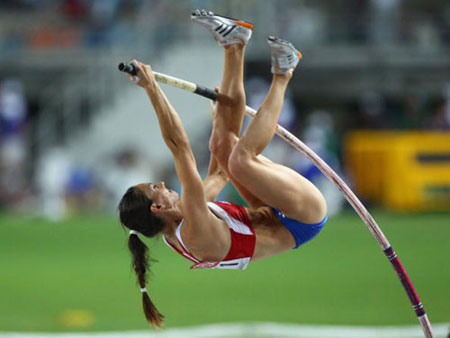
In her 2008 debut, Yelena Isinbayeva, 25, raised her own World record indoors to 4.95m today at the Pole Vault Stars meeting in Donetsk, Ukraine, and won a $50.000 bonus for eclipsing the top mark ever achieved indoors.

Isinbayeva, the reigning IAAF World Indoor Champion, added two centimetres to the previous indoor mark she set one year ago at the same venue, and won by 13 centimetres over teammate Yuliya Golubchikova, who finished second with a 4.72m clearance. Poland's Monika Pyrek placed third with a 4.67m vault.

Isinbayeva has now faced Golubchikova 20 times, and has gotten the better of her rival on each of those occasions - the final 13 coming as victories. Pyrek, the 2003 IAAF World Indoor bronze medallist (4.45m), has 11 victories in 63 competitions against Isinbayeva, and has not defeated her since winning the 2006 DN Galan in Stockholm.

This was the third-consecutive year in which Isinbayeva, who has leaped a world record of 5.01m outdoors, broke the indoor mark in Donetsk. Isinbayeva jumped 4.93m in Donetsk last year, and 4.91m in 2006.

Isinbayeva's winning mark today was her 22nd world record in the pole vault and was her first personal-best mark set in 12 months and 17 competitions. She also managed to clear 4.70m or higher for the 53rd time in her career. Isinbayeva had not competed since 2007-October-3 when she vaulted to a firsts-place 4.80m victory in Daegu, Korea.

Isinbayeva, who also is the reigning Olympic, World and European champion, has a 23-finals win-streak and has set world indoor records at least once during the past five seasons. She has been pre-selected to represent Russia at next month's IAAF World Indoor Championships in Valencia, where she will defend the title she won two years ago in Moscow.

Next up for the wealthy Russian is a stop in St. Petersburg on Monday to participate in the 2008 Laureus Awards, where the popular Russian will learn if she has been selected Sportswoman of the Year.

Justine Henin (Belgium, Tennis), Carolina Klüft (Sweden, Athletics), Libby Lenton (Australia, Swimming), Marta (Brazil, Football) and Lorena Ochoa (Mexico, Golf) are the other nominated stars up for the award.

Sergey Bubka, who holds the men's indoor and outdoor pole vault records and put on the meet, was on hand to witness Isinbayeva's record feat. Bubka set the still-standing world indoor mark of 6.15m in Donetsk in 1993. Bubka will also be in attendance Monday at the Laureus award show.


BEKELE BREAKS MENTOR'S 2-MILE RECORD

Birmingham, England -- Kenenisa Bekele, holder of four middle- and long-distance world records, struck again today at the Norwich Union indoor Grand Prix meeting, running two miles in 8 minutes 4.34 seconds, setting his third record at the English indoor venue.

Bekele, who earned a $30.000 bounty for breaking Haile Gebrselassie's indoor mark by a scant 0,34 seconds, was challenged by Paul Koech, the 2007 IAAF World Outdoor steeplechase champion, throughout the final mile until Bekele pulled away on the backstretch of the final lap.

Koech, who has a lifetime best of 7.33,93 outdoors in the 3.000m, ran to a new national Kenyan record of 8.06,48 in finishing second, with Abraham Chebii of Kenya finishing third in a personal-best time of 8.13,28.

Bekele and Koech lined themselves up to make it a 1-2 race following the final rabbit through the 1.600m mark, covered in 4 minutes 0,58 seconds. Bekele then assumed the pacing duties over his stalking challenger at the 2.000m mark, a split which he covered in 5.00,61. Koech appeared to bide his time as he sat back in second when Bekele put in a 59,8-second quarter split to break open the race.

Koech appeared to find a reprieve when Bekele slowed during the next 200m segment and fell off the blistering pace following a 62,9 split leading up to 2.800m, but the Kenyan finally felt the Ethiopian's pace's too much to handle once the pair hit the 3.000m marker in 7.34 -- one second off of Koech's personal best.

Bekele has done particularly well in Birmingham, having run a world record in the 2.000m (4.49,99) last season, and setting the current indoor 5.000m record (12.49,60) there in 2004.

Bekele made a valiant attempt in 2006 to break Gebrselassie's 2-mile world record -- which was also the Ethiopian national record, but fell 0,43 seconds short.

The 2008 indoor season is proving to be a highly competitive one leading up to the Olympic Games, with no less than four world records set within the past six days.

Select results from Birmingham:
Full results

1
Kenenisa BEKELE ETH 8:04.35


WR
2
Paul KOECH KEN 8:06.48


NR
3
Abraham CHEBII KEN 8:13.28


PB
4
Markos GENETI ETH 8:16.49


SB
5
Bekana DABA ETH 8:18.92


PB
6
Mo FARAH GBR 8:20.95


PB
7
Nick MCCORMICK GBR 8:26.44


PB
8
Erik SJOQVIST SWE 8:36.74


NR
9
Francisco ESPANA ESP 8:43.31


PB
10
Adam BOWDEN GBR 8:47.57


PB


Javier CARRIQUEO ARG DNF


Bikila DEMMA ETH DNF


Split Times
1000m
CARRIQUEO ARG
2:29.66
2000m
BEKELE ETH
(2:30.95) 5:00.61
3000m
BEKELE ETH
(2:33.99) 7:34.60
Finish
BEKELE ETH
(29.75) 8:04.35


2007-10-21

2007 Wishes Did Come True

Story written by EPelle

I made five requests of 2007 when putting together my wish list for this athletics season (blog entry), and by most accounts, I didn't waste precious space hoping for things further than the imagination could stretch. Though Marion Jones still bugs me, Trevor Graham still annoys me, and BALCO has continued living on despite the archaic form it has taken on the current events chart, I nearly struck pay dirt with the first item on my agenda, namely getting closer to a semblance of having clean sport and knocking some of the haughty riders off their horses -- including Jones and Graham.
  1. Clean sport. Athletics is closer to it than at this time last year, with Jones caught with her hands in the cookie jar, some (but not all) of her medal collection returned to the rightful recipients, and Graham facing an insurmountable battle with the U.S. Justice Department over lies, lies and even more lies. Bulgarian disgraces Venelina Veneva and Vanya Stambolova were both found to have been in violation of anti-doping rules and one athlete, France's Naman Keïta, accepted responsibility for having made his mistake. There was not much trouble turning the murky waters into wine with the public, metaphorically speaking, as fan support seems to have been relatively unchanged by negative press and nearly untouched by the positive events which unfolded in 2007 -- though I'd have wished that Tatiana Lysenko, the world-record holding Russian hammer thrower, could have avoided making news in this department. Veneva had long been suspected of drugs usage by her competitors following suspicious activities which saw Veneva take long absences from main stream competition, obtain good marks in obscure competitions inside of Bulgaria where the belief that drug-testing -- if it exists -- is at a bare minimum, then hit the championships with more power and better marks than she had at any other time of the season.
    "As [the way] she has set up her seasons and suddenly appeared at championships, I have understood that there was something shady. That she has finally gotten caught is an unbelievable relief, but one had hoped that it could have occured earlier," says Kajsa Bergqvist.
  2. Alan Webb did stay injury-free in 2007, but I still felt for guy following his 2007 IAAF World Championships performance when he'd been bitten by a flu-like bug which seemed to take his finishing kick and transform his legs from the Ferrari-backed motor he'd packed in there prior to his first heat to a local gym rat pushing uphill on a treadmill going nowhere fast. Webb never competes for "also ran" showings, and he laid it all down on the line in Osaka -- keeping himeslf in there from start to nearly the finish over the three laps and 300 metres which made up his 1.500m event in Japan. Webb proved in 2007 that he could keep things tightened under the belt in the middle distance department, focussing on the 800m (1.43,84 PB), 1.500m (3.30,54 PB) and mile (3.46,91 PB) events to set new best marks in each of the those, lead the world at the latter two, and set a national record in the mile; he recorded the year's second-fastest 800m. Webb seemed spent by the time his final was run, however, and had a less than successful follow-up on the Grand Prix circuit before closing out his season with a road mile victory in New York. All-in-all, however, he broke a long-standing record in Steve Scott's mile best, and outkicked Mehdi Baala on his home turf in prime time and under the lights in Friday Night fashion.
  3. Stefan Holm decided to stay with the sport in 2007 and continue on through Beijing in defense of his Olympic title. I had wished for Holm to win his first IAAF World Outdoor Championships gold medal, but one Donald Thomas would steal the thunder this season -- taking the world's highest available honour in his first-ever competition at that level. Holm finished out of medal contention with a fourth-place effort in Osaka. The season-ending best mark in the event -- 2,35m, which was shared by Thomas, Jaroslav Rybakov, Holm and Kyriakos Iannou -- was lower than I'd expected, but noteworthy about the "down" high jump year is that 30 athletes cleared 2.30m outdoors -- including seven by Russians and five by Americans. That left a lot of guessing at nearly every meet this summer as to which of those folks would win what, where, how and under which circumstances, and, almost as important as who would win the global title, who the number-one ranked athelte will be is completely up for grabs, too -- though Thomas seems to have the advantage in head-to-head battles. Thomas had a losing record against Holm, and "close" records against Linus Thörnblad and Tomas Janku, but Thomas beat Holm in their World Athletics Final clash, as did he Janku and Thörnblad. However, Thomas did lose to Thörnblad in Shanghai where neither Holm nor Janku competed. André Silnov, the 2006 European Champion, tied Thomas at 1-1 on the season due to Thomas no-heighting in Shanghai. Thomas's lone loss to Victor Moya was atoned for at the world championships. Holm had five losses on the outdoor season -- four of which were in his final four competitions.
  4. The world did not see Kenenisa Bekele at his best in the 2007 IAAF World Cross Country Championships in Mombassa, Kenya. Scorching humidity and heat ended the reign of the Great Bekele, who did not complete the race following a late charge to take the lead, and threw his track and field season off as well. For once, Bekele was made human over the hills, and scooped up times and marks on the track which scraped any hopes of him doubling at the IAAF World Championships in an equally hot and humid Osaka. Bekele had commanded my total respect for disabling competitors upon demand and playing catch with fire since his initial double-double IAAF Cross Country World Championships victories in 2001, and in the winter of this year, he became the first man to break 4.50 over 2.000m indoors, running 4.49,99 at the Norwich Union Grand Prix. His competitors, however -- many of whom were his compatriots -- gained new-found hope and life in believing they could make a challenge of defeating the weaker, non-dominant Kenenisa Bekele a reality over 25 laps to be run at 21.40 on a hot August evening, the 27th of August -- first and foremost Sileshi Sihine, who stuck it to Bekele in a masterful and memorable final lap, but one which saw Bekele turn back the charge and create a silver-medalist out of Sihine again following their identical finish two years earlier in Helsinki, which followed their identical finish at the Athens Olympics as well. Sihine has collected three silver medals and a bronze at either the World Championships or Olympic Games. Bekele was able to record the year's three-quickest outdoor 3.000m times, running 7.25,79 - 7.26,69 and 7.29,32. Bekele's world-leading mark is the eighth-fastest of all-time, and he's the sixth-fastest ever at the distance.
  5. The final golden moment of 2007 was to have been Kajsa Bergqvist jumping over 2,09m either indoors or out. She didn't. Kajsa had trouble hitting 2,00m this outdoor season as she found it difficult to balance ground training her coach, Yannick Tregaro, had wished for her to endure versus getting in quality meets which she believed would help her reach her season's potential, which she felt was certainly higher than the 2,02m she recorded in Torino. Bergqvist would separate from Tregaro's group following the World Championships. Bergqvist had my hope button alive with talk of improving her world record in 2007, but it was Blanka Vlašic who made headlines this season. Bergqvist made it clear in no uncertain terms last winter that she was going to make an assault on the 16-year-old world indoor record of 2,07m held by Heike Henkel, and she eclipsed that mark with Henkel in attendance, jumping 2.08m in Arnstadt on 2006-February-4. She then made a pact to give a go at seriously attempting to take down Stefka Kostadinova's 2,09m from Rome set 19 years earlier. That perfect-day, best-ever jump was not to unfold outdoors in 2006, leaving Bergqvist even more loaded and focused from having missed nearly a year-and-a-half following her ruptured achilles injury suffered in the spring of 2004. What Bergqvist hadn't had time to see as she struggled in chartering for green pastures in the world record pursuit was that Vlašic had found incredible focus and determination during the indoor season, and was able to translated that to a near-undefeated outdoor campaign, topping the yearly list at 2,07m, and also jumping 2,06m, twice clearing 2,05m and finishing two other competitions with 2,04m victories; she toppled the 2,00m barrier in an incredible 17 competitions in 2007. Her lone defeat was a second-place finish at the Oslo Golden League to Yelena Slesarenko, who at that early time, was in contention for the $1.000.000 Golden League jackpot. Vlašic had the misfortune of having her only loss of the season come in the Golden League, and also missed out on the jackpot. Russia's Anna Chicherova as well as Italy's Antonietta Di Martino brought their "A" game to the World Championships, where I'd hoped that clearing 2,04m would only yield a bronze to the third-best of the group. Both athletes cleared 2,03m, with Chicherova taking the third spot on the podium. The most women ever to clear 2,00m in an IAAF World Championships final before Osaka was three, but five women in Japan went on to attempt 2,03m -- with four successful over 2,00m. Slesarenko had the misfortune of finishing fourth in 2,00m, with compatriot Yekaterina Savchenko the fourth over the same height -- making that three Russians over 2,00m in the same competition. Bergqvist finished tied for seventh with a best of 1,94m.
A thousand other small wishes came true throughout the 2007 season as well, with Asafa Powell setting a new world record in the 100m (9,74) and me having had the opportunity to meet Xavier Carter in person (Glasgow). I had also hoped that Carolina Klüft could finally break the European record in the heptathlon. She was able to manage that in Osaka, amassing 7.032 points and becoming the second-best performer of all-time behind American Jackie Joyner-Kersee.

I'd also hoped for a season of faster times and good marks, and 2007 did not disappoint in that category, either, with Allyson Felix running excellent 200m (21,81) and 400m (49,70) times in Europe and Osaka, and a stellar 48-flat relay leg on the winning 4x400m at the IAAF World Championships. Tyson Gay blazed an incredible 9,84-19,62 at his national championships, and U.S. collegian Walter Dix screached to 9,93 - 19,69 times whilst in university competition.

Finally, not to continue touting my Swedish team, but Johan Wissman's 400m exploits this summer -- culminating in a seventh-place finish at the World Championships following a national-record 44,56 in the semi-finals -- was one of those hidden gems which made wishes worth making and dreams worth having.

Now that the season is virtually concluded (although there was a 10,10 100m recorded last week at the World Military Games), I'll have time to finally sit back and reflect on what was truly inspiring, and which athletes I believe can provide me the greatest entertainment value leading up to Beijing.

Until then, I'm going to enjoy cross country and the road races around Europe. I hate to admit this, but I am a bit "tracked" out.

2007-06-11

Mottram (8.03,50) Wins Pre 2-Mile Classic

Story written by EPelle

Australian Craig Mottram, a 2007 IAAF World Championships 5.000m gold medal hope, won the Prefontaine Classic Grand Prix 2-mile yesterday evening - smashing nearly nine seconds off his previous personal best and Australian record, and in the process, clocking the sixth-fastest time ever in the distance, 8.03,50.

Mottram entered the meet after suffering a slight setback at the
Reebok Grand Prix in New York last week (results link), finishing third in the mile (3.54,54 SB) to Americans Alan Webb (3.52,94) and Bernard Lagat (3.53,88), but bounced back in superb fashion in the 12-strong field Sunday, covering his mile splits in 4.04,0 and 3.59,5.

"It's a win and it is better than last week and better than three weeks ago and I will be a lot better in two months. I was strong today. I will take the fast time but it doesn't mean much come August; I will have to beat five or six more of them," he told the
Register-Guard.

Mottram handed Ethiopia's
Tariku Bekele (8.04,83) a spirited defeat in front of a standing-room only crowd at the University of Oregon's Hayward Field, which let out a loud roar when third-place finisher, American Matt Tegenkamp, crossed the line in 8.07,07 - setting an American record by sheering more than four seconds off of the two-year-old record national standard set at the 2005 Pre Classic. Free video of the race can be found here courtesy of NBC.

Bekele, who is the younger brother of 5.000m and 10.000m world-record holder
Kenenisa Bekele, holds 7.29,11 3.000m and 12.53,81 5.000m personal bests - both Ethiopian national junior records, is 0-5 lifetime against Mottram. They've clashed twice at 5.000m (13.03,37-13.12,49 in Bislett in 2004; 13.32,96 - 13.34,76 at the 2005 World Championships), and the young Ethiopian has also been unsuccessful at beating Mottram indoors at the 2-mile distance, with Mottram winning the 2005 BIG Boston indoor Games in 8.26,54 to Bekele's 4th-place 8.27,56. Mottram also defeated the younger Bekele in their only 3.000m clash as well, with Mottram finishing third in the 2005 Zürich Weltklasse in 7.38,03 to Bekele's ninth-place 7.43,47.

Webb set the previous American record in finishing 2nd in the 2005 Pre Classic 2-mile to Kenya's
Eliud Kipchoge, 8.07,68 to 8.11,48, but managed only a ninth-place finish (8.23,97) on Sunday.

Mottram lingered back in the middle of the pack for the first 1.320 yards of the eight-lap race right in front of Webb, but made a decisive move up behind Bekele and the two pace-makers in the race to hit a very good first mile split at a desirable pace (rabbits were asked to split 4.03).

Bekele and Mottram held tempo and command of the race, and made decisive moves at the beginning of the final lap, but Tegenkamp, who began making a long charge with three laps remaining - running just ahead of American
Dathan Ritzenhein (8.11,74) - had launched into his own extended kick with 300m remaining.

Mottram passed Bekele on the backstraight with approximately 250m remaining and held a comfortable lead heading into the homestretch - where he began waiving to the crowd with 40m remaining. Neither Bekele nor Tegenkamp were able to gain on Mottram following his explosive kick.

Mottram, whose previous best was established in a victory over Kenya's
Boniface Songok - 8.11,27 to 8.12,86 - at the 2005 Norwich Union Grand Prix in Sheffield, England (results link), holds seven track and road national Australian records, and appears to be in excellent form heading to the world championships to be contested in August in Osaka, Japan, where he is one of the favourites.

Mottram's 2-mile time equates to a 7.27,69 3.000m according to Track & Field News, with Bekele's new personal best equating to a 7.29,85, followed by Tegenkamp netting a 7.31,0 equivalent.

"It's too early to get too wound up about the world championships just yet," Mottram said to Australia's
Herald Sun newspaper.

Indeed, the European season has not yet kicked off (the Oslo Golden League Meet is first on tap this Friday), yet Mottram is in excellent position heading into what promises to be an exciting year for the 2005 bronze medalist at 5.000m, and 2006 Commonwealth Games champion.

The world two-mile record - 7.58,61 - was set by Kenya's
Daniel Komen in Hechtel, Belgium in 1998. Komen, the only man who has broken the eight-minute barrier, twice achieved the mark, with his second-best effort - 7.58,91 - set in a 1998 blow-out in Sydney, Australia. The only other person on the all-time in front of Mottram is Ethiopia's Haile Gebrselassie, the outer-worldly two-time Olympic and nine-time World Champion (indoors, outdoors, road), who ran 8.01,08 in Hengelo in 1997, and followed that effort up with great performances at Hengelo (8.01,86) and London (8.01,72) two seasons later.

Mottram is traveling back to his London base camp in preparation for his first
European Circuit race on 27-June in Ostrava Golden Spike meeting, where he will contest the Emil Zatopek Memorial 5.000m (meet site), a favourite stop for early-season fast times and excellent racing. Kenya's Stephen Cherono holds the meet record in the event, running 12.48,81 there in 2003.

Mottram holds a lifetime best of 12.55,76 in the 5.000m, and has broken the magical 13.00-minute barrier a total of three times (12.56,13, 12.58,19).

The top-10 2-mile times outdoors:
  1. Daniel Komen (KEN) 1997 7.58,61
  2. Daniel Komen (KEN) 1998 7.58,91
  3. Haile Gebrselassie (ETH) 1997 8.01,08
  4. Haile Gebrselassie (ETH) 1999 8.01,72
  5. Haile Gebrselassie (ETH) 1999 8.01,86
  6. Craig Mottram (AUS) 2007 8.03,50
  7. Daniel Komen (ETH) 1996 8.03,54
  8. Tariku Bekele (ETH) 2007 8.04,53
  9. Matt Tegenkamp (USA) 2007 8.07,07
  10. Haile Gebrselassie (ETH) 1995 8.07,46
Mottram's Personal Best Track Times:
  • 1.500m: 3.33,97
  • Mile: 3.48,98 (3.54,81 indoors)
  • 2.000m: 4.50,76
  • 3.000m: 7.32,19 (7.39,24 indoors)
  • 2-Mile: 8.03,50 (8.26,54 indoors)
  • 5.000m: 12.55,76
  • 10.000m: 27.50,55
For a full-list of the all-time 2-milers, please go to www.alltime-athletics.com, or click this link here for immediate access to the list.

2007-01-16

Bekele Fires Away at IAAF

Story written by EPelle

Kenenisa Bekele, who on Saturday displayed one of the most specatacular winning performances of his career at the Event Scotland Great Edinburgh International Cross Country 9,3km race, is at odds with the IAAF, stating he is receiving unfair treatment from the international federation due to being African.

Bekele, who was selected IAAF World Athlete-of-the-Year in 2004 and again in 2005, received no compensation for winning the international prize. However, neither did Yelena Isinbayeva, the women's winner those same two seasons.

"That cannot be right," said Bekele (source), "did they treat me differently because I am an African?"

The argument stems over Asafa Powell and Sanya Richards having both winning $100.000 for their selections this past year - a new style nomination system the IAAF has put into place to award the top athletes in the world.

"I am adamant that I will not be going to Mombassa," said Bekele following his victory Saturday.
Bekele's exclusion is thought to draw a marketing blow to the IAAF, as the 10-time world cross country champion has decideded against contending for an 11th title, and has warded off rumours that he will be pressured by Ethiopia's Athletics federation to run, nonetheless.

"That is not true, I have spoken with them and they accept my decision," said Bekele, stressing his non-appearance has nothing to do with his belief the IAAF have treated him unfairly, nor an acting out against the location of the meet - in arch-rival Kenya's backyard.

Bekele's adamant stance toward the championship event could be a blow to the IAAF, as Kenyan Mike Kigen, who was fifth in the 2006 IAAF Championships event in Japan, will not compete in Mombasa due to an injury, and Isaac Songok, the reigning 4km silver medallist, and Augustine Choge have quit cross country running all together.

However, The Herald (source), quotes Bekele playing a different tune.

"If there is something special, I may run," he said. "If there's a special challenge, specially for the world champion man. I won many years, the world cross. It's the same every time, and there's nothing special.

"Maybe the organisation, the IAAF, they should put something special for the world champion man. Some special prize money? Yes. If I lose this race, for me it is a big thing.

"They could pay a performance bonus for me to run. Maybe it's possible for them. If they encourage sport, or something. Every time you run, nothing is achieved."

Bekele started his amazing run at cross country stardom was borne in 2001 - his final year as junior athlete, when he completed an astonishing double at 2001 World Cross Country Championships, finishing 2nd in the elite men's short-course (4km) race to Kenyan Enock Koech on the first day, and returning the following day to add an overwhelming 33 second victory in the junior race.

The following year, Bekele went on to win both the long course race and the short course events - becoming the first man to ever win both events, and has never looked back, winning both events again in 2003, 2004, 2005 and 2006, for a whopping 10-straight indivudal titles to go along with his junior title.

Bekele's first global track gold came at the front of an intimidating Ethiopian sweep in the 2003 IAAF World Championships 10.000m in Paris, where Bekele broke the field with a 12.57,24 final 5.000m for a 26.49,57 championship record.

2007-01-13

Bekele Opens 2007 in Winning Fashion

Story written by EPelle

Ethiopia's Kenenisa Bekele, winner of five consecutive IAAF World Cross Country Championships long- and short-course titles, obliterated his competition at the Event Scotland Edinburgh international Cross Country today, winning on the 9,3km course in 28.14.

Bekele, who has both sworn off and then verbally reconsidered competiting for any further accolades in the spring championships, defeated rival 10.000m runner Zersenay Tadesse Zersenay, the 2004 Olympic Bronze medalist, by 10 seconds.

Bekele's arch Kenyan rival Eliud Kipchoge, who, like Zersenay, became the first athletes to run under 27.00 over a 10km course in Spain two weeks ago, finished in third place, 37 seconds behind Bekele (full results).

According to a race description provided by onrunning.com (link), Bekele produced one of the most spectacular displays of running ever seen during a race at the elite level, when, with three laps remaining of the 9,3km course, he upped the ante and dropped his opponents - a move none were able to counter.

Ethiopian teammate Gelete Burka captured the women's 6,1km race in 23.25, nine seconds ahead of both Vivian Cheruiyot (2nd) and Benita Johnson, who finished with the bronze.

The reigning Olympic (2004) and World 10.000m (2003) champion extended his cross country winning streak to 26-straight since suffering his last defeat to Haile Gebrselassie in December 2001. He was pushed to the wire by Saif Saaeed Shaheen last year, when Bekele described himself as being tired, but was focused and prepared on this year's race.

"It was a good beginning to 2007," Bekele is quoted as stating by onrunning.com.

"I am very happy that I won my first race of the year.

"I expected it because of the training I have done."

Bekele, by far the most gifted cross country and long distance track athlete on the planet, stated yesterday that he lacks motivation to continue running in the world cross country championships.

"The motivation may not be there any more," he stated yesterday, according to The Herald (link).

"I don't know if I have the same hunger," he confided.

"That's why I won't do the world-cross again. I still want to improve my times, run fast on the track. I may try for some world records this year. I don't know where, or which one, either the 5000 or 10,000 metres. They are both my favourite events, but I think the 5000m record is harder."

However, IAAF post-race reports quote Bekele as stating he may consider running at the Cross Country World Championships if there is a new challenge.

Bekele’s manager, Jos Hermens, said that the 24-year-old Ethiopian is only 80 per cent fit, adding “he is a little bit chubby and could have been more prepared,” something one should possibly take with a grain of salt.

Bekele, who has broken 13.00-flat 13 times in his career, set the world 5.000m record of 12.37,35 in Hengelo nearly three years ago, swiping 2,01 seconds from Haile Gebrselassie's world and national record time of 12.39,36 set in Helsinki six years before that.

He first set the 10.000m world record of 26.20,31 in Ostrava in 2004, and eclipsed that with a mark of 26.17,53 one year later in Bruxelles.

Gebrselassie held the previous world record (26.22,75), a mark which he set in Hengelo in 1998.

The Herald quotes Bekele has stated that doubling up at either this August's world championships or next year's Olympic Games would be off the cards, citing that he'd prefer to race great in one race, rather than run two poor races.

Bekele was upstaged in the 2003 IAAF World 5.000m Championships in Paris after taking the 10.000m gold when Kipchoge (12.52,79) held off mile world-record holder Hicham El Guerrouj (12.52,83) by 0,04 seconds for the gold, with Bekele finishing with a bronze (12.53,12).

Bekele tried his hand at the double the following year in Athens, winning the 10.000m (27.05,10) ahead of teammate Sileshi Sihine (27.09,39) and Tadesse (27.22,57), but falling short to a reverse 1-3 world champs finish from El Guerrouj (13.14,39) and Kipchoge (13.15,10), running 13.14,59 to earn silver in a race which played into El Guerrouj's hand as a strong kicker.

Two years ago, running in his third major track championship, Bekele opted to contest the 10.000m only, narrowly edging out Sihine (27.08,87) and Kenyan Moses Mosop (27.08,96) by a total spread of 0,63 seconds. Bekele was tested to the limit and ran 27.08,33 - the 2nd-fastest winning time in meet history behind his 2003 triumph (26.49,57) - a race which he negative split under 13.00 to close out the 2nd 5.000m segment.

Perhaps it is high time for Bekele to rest during the spring months, and get in optimal athletics training for the busy summer ahead. He has demonstrated the capability to run hard and run fast following cross country training, and even snuck in a gold medal in the 3.000m at the 2006 IAAF World Indoor Championships to boot.

It shall be a marvel to see what Bekele can do in 2007 with his concentrations focussed specifically on the track rather than the hills.

Kenenisa Bekele was born 1982-13-June in Bekoji, Arsi Province, Ethiopia.

He holds personal bests of 3.33,08 (2006), 7.30,67 (2001), 12.37,35 (2004), 26.17,53 (2005) and 42.42 over 15km (2001).

9,3km Results (Courtesy IAAF):
Men’s Race (9.3km)1 K Bekele (ETH) 28:14; 2 Z Tadesse (ERI) 28:24; 3 E Kipchoge KEN) 28:51; 4 F Joseph (TAN) 28:52; 5 G Gebremariam (ETH) 29:00; 6 D Ritzenhein (USA) 29:02; 7 S Bairu (CAN) 30:34; 8 A Letherby (AUS) 30:35; 9 C Rooney (IRE) 30:43; 10 T Abyu (GBR) 30:51.

Bekele's achievements to date:

  • 2006 1st African Championships in Athletics 5.000m
  • 2006 1st IAAF Short Race World Cross Country Championships
  • 2006 1st IAAF Long Race World Cross Country Championships
  • 2006 1st IAAF World Indoor 3.000m
  • 2005 1st IAAF Short Race World Cross Country Championships
  • 2005 1st IAAF Long Race World Cross Country Championships
  • 2005 1st IAAF World Track & Field Championships 10.000m
  • 2004 1st IAAF Short Race World Cross Country Championships
  • 2004 1st IAAF Long Race World Cross Country Championships
  • 2004 1st Olympic Games 10,000m
  • 2004 2nd Olympic Games 5.000m
  • 2003 1st IAAF World Track & Field Championships 10.000m
  • 2003 3rd IAAF World Track & Field Championships 5.000m
  • 2003 1st IAAF World Short Race Cross Country Championships
  • 2003 1st IAAF World Long Race Cross Country Championships
  • 2002 1st IAAF World Short Race Cross Country Championships
  • 2002 1st IAAF World Long Race Cross Country Championships
  • 2001 1st IAAF World Junior Cross Country Championships

2007-01-05

Farah Picked for IAAF XC Championships

Story written by EPelle

Great Britain's Mo Farah, winner of the 2006 European Cross Country title last month, is one of six athletes UK officials have pre-selected for Great Britain at the IAAF World Cross Country Championships in Mombasa, Kenya, on 24 March.

Farah, who turns 24 in March, was named for the senior men's team, while Jo Pavey and Hayley Yelling will toe the line in the senior women's race.

European Junior Cross Country Champion Stephanie Twell will lead the junior team, with pre-selections provided to Emily Pidgeon and Sian Edwards, respectively.

News site onrunning.com quotes Farah as stating that his new-found cross country success will not take his focus off of his long-term plan, namely participating in the 2007 IAAF World Track & Field Championships in Osaka.

"I have always said the summer's World Championships remain my top priority and nothing will alter that."

"But I'd also like to compete at the European Indoors because they are on home soil."

Indeed, it seems fit that Farah would likely contest the 3.000m in Birmingham in March in front of home supporters filled with high expectations for the Somali-born Brit, having placed sixth in the 2005 World Indoor Championships in Madrid (7.54,08 PB) - a race which saw Kenenisa Bekele (7.39,32), Saif Saeed Shaheen (7.41,28) and Eliud Kipchoge
finish 1-2-3.

Farah found success managing the 7,5-lap distance last summer, setting an outdoor personal best time of 7.38,15 in Zagreb. This past summer marked the first time Farah would ever break 8.00 outdoors.

The greater successes he earned were at the longer distances, however - at 5.000m, a distance at which he won the 2001 European Junior Championships (14.09,91) in Grosseto, Italy over Bruno Saramago of Portugal (14.11,65) and Spain's Noel Cutillas (14.12,43). Farah placed 10th at the 2000 World Junior Championships held in Santiago.

Farah's rise to the top of internationl respectability earned terrific stock when he earned the European 5.000m silver medal (13.44,79) here in Göteborg at the 2006 European Championships, essentially tranferring over his junior potential to the senior scale.

Farah, who has five English Schools titles to his name, showed signs of toughness prior to the championships in setting a 3.000m PB at the British Grand Prix at Gateshead, running 7.45,25 for a seventh-place finish. He followed that up with a tremendous breakthrough, running a personal-best time of 13 minutes 9,40 seconds in the 5.000m at the KBC Night of Athletics meet in Heusden, Belgium - a time which ranks second on the UK All-time list behind David Moorcroft's previous world-record of 13.00,41.

Farah is riding a high wave of new-found success, but first he must tackle on the task of making a great showing at the upcoming world championships in Kenya, for which he has been pre-selected in hopes of helping team Great Britain to fight for a medal. Farah took home the European Cross Country title by making a move in the 25th minute - a gutsy effort which no competitor matched in the race. His gold medal was never in danger as he completed the final two minutes of the race.

Having locked up the top spot, Farah became the first Briton to win an individual European cross country title in over a decade, following in Jon Brown's footsteps. Farah took home the title last month by covering the 9.950m course in 27.56 (2.49/km), holding a very comfortable lead over runner-up Fernando Silva of Portugal. UK fans and officials alike hope that Farah can continue building on the momentum he established in 2006, and make an international cross country break-through.

He placed 40th in the 2006 IAAF World Cross Country Championships short-course race (4k), and 21st in the 2005 European Cross Country Championships, but fared much better against Europeans in 2005 IAAF World Cross Country Championships
.

Farah has a very enduring stretch of racing ahead of him, with his ultimate goal medaling in Osaka. Following the world cross country championships, Farah will head over to Northern California, where he plans on contesting the Cardianl Invitational 10.000m held at Stanford University before heading into the beginning of the Grand Prix season.

"I'll be going to California and might run at 100000m at Stanford."

Here's hoping Farah enjoys greater success and remains injury-free as he plans his long flight through the ranks to the medal round in Osaka.

Mo Farah's Personal bests:

  • 1.500m: 3.38,62 Zürich, 19 Aug 2005
  • Mile: 3.56,49 London 6 Aug 2005
  • 2.000m: 5.06,34 Melbourne 9 Mar 2006
  • 3.000m: 7.38,15 Zagreb 31 Aug 2006
  • 5.000m: 13.09,40 Heusden 22 Jul 2006
  • 5km: 13.30 Stranolar (Ire) 26 Dec 2006
  • 10km: 28.37 NYC 21 May 2006
  • 10 Mile: 48.59 16 Oct 2005

NB: Farah placed second today to Sergiy Lebid over 4km at the 2007 Men's Great Edinburgh Cross Country, running 12.21 - one second behind Lebid.

NB: Farah placed sixth in today's (2007-Jan-7) 10,7km Zornotza Internacional race in Spain

Men (10.7Km) 1. Micah Kogo (Ken) 32.03 2. Tariku Bekele (Eth) 32.03 3. Joseph Ebuya (Ken) 32.04 4. Abiyote Guta (Eth) 32.04 5. Moses Masai (Ken) 32.19 6. Mohamed Farah (Gbr) 32.22 7. Juan Barrios (Mex) 32.48 8. Ali Abdallah (Eri) 33.06 9. Cutbert Nyasango (Zim) 33.26 10. Andrew Letherby (Aus) 33.27

Lagat, Mottram Headline Millrose Fields

Story written by EPelle

Three-time American record-holder Bernard Lagat and Australian Craig Mottram, who holds six national records, will headline the Wanamaker Mile at 100th Millrose Games to be held at Madison Square Gardens on 2-February.

Lagat, a two-time Olympic 1.500m medalist and reigning USA 1.500m and 5.000m champion, set the American indoor mile (3.49,89) and 1.500m (3.33,34) records at the Powered by Tyson Invitational in Fayetteville, Arkansas, USA two years ago.


Lagat set his third American record, outdoors at 1.500m, with a time of 3 minutes 29,30 seconds at the 2005 Rieiti Grand Prix.

Lagat also owns the second-fastest American outdoor mile (3.48,38) and 5.000m (12.59,22) times recorded.

Steve Scott (3.47,69 - Oslo, 1982) and Bob Kennedy (12.58,21 - Zürich, 1996) hold the American mile and 5.000m records, respectively. Scott (3.51,8/1981) and Jeff Atkinson (3.38,12/1989) held the previous mile and 1.500m American indoor records.

Lagat has personal bests of 3.26,34 at 1.500m and 3.47,28 in the mile - times recorded prior to becoming an American citizen in 2004.


Lagat, seen above holding the 2005 Wanamaker Mile trophy (photo courtesy of Trackshark.com), will be seeking his fifth Wanamaker Mile victory, having won the 2005 edition in 3.56,85 in defeating Kenenisa Bekele, who was making his debut at the shorter distance.

If Lagat successfully defends his title, he will tie Irishman Marcus O’Sullivan for the third-most victories on the all-time Wanamaker Mile list, behind only Eamonn Coghlan (seven) and Glenn Cunningham (six). O'Sullivan holds the record for most sub-4 times recorded in the Wanamaker Mile, topping the list at 11.

Coghlan, who was the first man to break 3.50 indoors, running 3.49,78 in 1983 at the Meadowlands in New Jersey, USA - the fastest time ever recorded in the United States - won seven Wanamaker Mile titles (4.00,2 in 1977; 3.55,0 in 1979; 3.58,2 in 1980; 3.53,0 in 1981; 3.54,4 in 1983; 3.53,8 in 1985; and 3.55,9 in 1987).
Coghlan also competed in three Olympic Games, and won the 5.000m (13.28,53) at the inaugural IAAF World Track & Field Championships in Helsinki.

Among Lagat's challengers will be Australian Craig Mottram, who will be making his Millrose Games debut, though he will not be making his first running appearance in New York.

Mottram was the 2005 IAAF World Championships bronze medalist at 5000m (13.32,96), the first non-African to win a medal at that distance in a major championship since 1987, when Coghlan, mentioned above, won his world championship gold.

Mottram is also a two-time IAAF World Cup winner at 3.000m, running 7.41,37 in Madrid in 2002, and upsetting Bekele for the victory in 2006 with a 7.32,19 - also an Australian Record.

Mottram first gained international track & field notoriety when he broke 13.00 over 5.000m, running an Australian (and Oceanic) record of 12.55,76 in London in 2004 - narrowly losing to Haile Gebrselassie (12.55,51 All-comers record).

Mottram has also been a force on the fields as well, having placed 11th, ninth, fifth and eighth in the IAAF World Cross Country Championships short-course races (in descending chronological order), and 22nd and 13th in the long course races.

Mottram owns national records at the mile (3.48,98/Oslo, 2005), 2.000m (4.50,76/Melbourne, 2006), 3.000m (7.32,19/Athens, 2006), 2-miles (8.11,27/Sheffield, 2005), 5.000m (12.55,76/London 2004) and 10km road running (27.39/Madrid, 2006).

Mottram is large in stature, measuring 1.88m, and may have a disadvantage trying to kick past lagat on the tight turns on the 11-lap track. However, Mottram has pushed the pace in championship races, so a break away attempt to try gapping Lagat in a highly-publicised invitational may not be out of the question.

The last time these two locked up head-to-head over the 1.760-yard distance which is the mile, Lagat set his name in the US history book (2nd all-time), and Mottram set a national record.

Mottram set a 10km road best - and Australian record - in Madrid at the San Silvestre Vallencana race six days ago, running 27.39 on a course slightly too downhill for IAAF record purposes. Though he set an all-time best, he suffered defeat to Kenya's Eliud Kipchoge (26.54) and Eritrea's Zersenay Tadesse (26.54), the first two athletes to ever break 27.00-flat on any course.

Mottram also had a 10-race 10km win-streak ended in the process.

The sparks may not fly as high during the Millrose Games Wanamaker mile, as this is neither peak nor championship time for either athlete. However, the excitement fans will gain by watching them lock head-to-head will be there, nonetheless!

Stay tuned for more of what promises to be an exciting Millrose Games.

Mottram's Personal Bests (IAAF):

  • 1.500m: 3.33,97 Zürich 18 08 2006
  • Mile: 3.48,98 Oslo 29 07 2005
  • 2.000m: 4.50,76 Melbourne 09 03 2006
  • 3.000m: 7.32,19 Athens 17 09 2006
  • 2-Mile: 8.11,27 Sheffield 21 08 2005
  • 5.000m: 12.55,76 London (CP) 30 07 2004
  • 10.000m: 27.50,55 Melbourne 04 12 2003
  • 10KM: 27.39 Madrid 31 12 2006

Lagat's Personal Bests (IAAF):

  • 800m: 1.46,00 Berlin 10 08 2003
  • 1.000m: 2.18,70 Sydney 14 09 2000
  • 1.500m: 3.26,34 Bruxelles 24 08 2001
  • Mile: 3.47,28 Rome 29 06 2001
  • 2.000m: 4.55,49 Stockholm 30 07 1999
  • 3.000m: 7.33,51 Monaco 18 08 2000
  • 5.000m: 12.59,22 London (CP) 28 07 2006

Millrose Games Homepage